


This is part one of a two-part series: Part one provides the framework for spotting a Michelin star restaurant in the making. Part two applies this framework to the serious 2026 London openings to predict the restaurants most likely to be awarded a star in 2027.
Since 2022 there were 44 restaurants who earned their first Michelin star (or two).
I analysed every newly awarded star across five consecutive Michelin ceremonies (2022-2026).
I looked at opening dates, chef histories, ownership structures, and format.
I wanted to see whether the recognition that looks retrospectively obvious actually had signals at the point of opening.
It did. Three of them.
I’m calling these signals Pedigree, Format, and Platform.
Individually, each one barely moves the odds, but stacked together they’re close to a guarantee: of the fifteen restaurants to open with all three signals across five years, thirteen had a star within twelve months, the remaining two got their star in year two. That’s a 100% conversion rate to star.
Three signals that predict a future Michelin Star
Pedigree

Pedigree is a chef’s traceable lineage through kitchens Michelin already trusts. Not just “has worked in a starred restaurant” (that’s table stakes at this level) but specifically, has this person held a senior or leadership role in a kitchen operating at two or three stars? Both Clare Smyth and Matt Abé ran Restaurant Gordon Ramsay as head chef. Alex Dilling was head chef at a two star before he opened his own room at the Café Royal and went straight to two stars within six months of opening. That’s a different kind of signal than having staged at a three-star in your twenties.
Pedigree is essentially a proxy for invisible quality. It tells an inspector, before they’ve eaten a single course, that this person has been inside the machine, they know what that level of execution looks like from the inside, not from the outside looking in.
The kitchens that produce this signal most reliably: Le Gavroche, The Fat Duck, L’Enclume, Restaurant Gordon Ramsay, and Hélène Darroze, The Ledbury. Five of the 44 London stars awarded between 2022-2026, trace chef pedigree back to Restaurant Gordon Ramsay.
Pedigree as a signal works because Michelin is recognising something it has already rewarded, which makes it the most reliable predictor in the framework.
Format
Format is about clarity. Specifically, how quickly can an inspector form a confident view of what this restaurant is trying to be?
A tasting menu is the clearest possible way to do that. The chef has edited down to ten or so courses they stand fully behind. The price is set, the ambition is explicit, and an inspector can assess the entire arc in a single visit.
An à la carte room requires multiple visits, you might have ordered the wrong things, the kitchen performs differently at lunch, the register is harder to read. The same quality of cooking, assessed through two different formats, will be recognised at different speeds.
This is why omakase counters and chef’s tables star so quickly across cuisine types. It’s not because Japanese food is easier to recognise than West African food.
Rather the format, a set sequence, counter seating, one plate at a time, is an unambiguous sampling of what the kitchen can do. For restaurants that earn a star in their first year, this format compresses the assessment timeline significantly.
Platform
Platform is the organisational infrastructure behind the restaurant, who built it, who funded it, how established the operation is.
The two types that matter are luxury hotels and experienced restaurant groups. A restaurant opening inside The Peninsula or the Four Seasons arrives fully capitalised: full team, proper wine storage, trained front of house, none of the corners cut that every young independent has to figure out in their first year.
An experienced group like JKS or Jason Atherton’s operation brings existing supplier relationships, tested infrastructure, and (not irrelevant) an existing relationship with inspectors from prior restaurants.
What platform eliminates is a very specific question an inspector has to resolve before awarding a star: is this place going to still be here in two years?
A restaurant at Raffles is not going to close because the chef ran out of cash, that confidence accelerates the star.
Why the three signals compound
Each signal removes a different source of uncertainty.
Pedigree answers: can this chef cook to this level?
Format answers: can I assess that on a single visit?
Platform answers: is this a stable proposition worth committing to in print?
When all three are present simultaneously, there’s almost no basis for hesitation. Which is exactly why Alex Dilling, Brooklands by Claude Bosi, and Bonheur by Matt Abé all went straight to two stars within their first year. Remove any one of the three signals and you reintroduce a source of doubt that adds, at minimum, another year before the star arrives.
What this looks like in practice
Bonheur by Matt Abé is the cleanest illustration of all three signals working simultaneously. Abé spent years running Restaurant Gordon Ramsay, not staging, not as sous chef, but as head chef of a three-star kitchen, before opening on the site of Le Gavroche in Mayfair.
That address carries more culinary weight than almost anywhere else in the UK: the room where the Roux brothers defined what serious French cooking looked like in this country, where Marco Pierre White trained, where a generation of chefs learned their trade.
Opening there is itself a declaration of intent. Add a fully capitalised backed venture with the infrastructure to open complete, and you have a restaurant that removed every source of inspector hesitation before the first service. The result: two Michelin stars on first recognition, within months of opening.
Corenucopia and Legado are more instructive because neither has all three signals. Both earned a star in year one on two signals, which makes them useful to look at side by side.
Clare Smyth is her own platform. When Corenucopia opened in December 2025, it arrived with her senior Core team intact, head chef, restaurant manager, head sommelier, plus a decade of inspector relationships, established supplier networks, and a team already calibrated to three-star execution, the pedigree is self evident. What she didn’t bring was the tasting menu. Corenucopia is a luxury bistro: à la carte, fish and chips made with Dover sole and lobster mousse, no ten-course menu declaring its ambition upfront. The format signal is absent, but one star, year one, regardless.
Legado makes a parallel argument from a different starting position. Nieves Barragán Mohacho built Sabor into one of London’s most respected Spanish restaurants and earned a star there. Behind Legado sits JKS Restaurants (whose portfolio includes Gymkhana, Trishna, Ambassadors Clubhouse, as well as others) one of the most credible operators in the city. Pedigree and platform are both strong. Format: an open kitchen, counter seating, dishes from across Spain, à la carte. Again, no tasting menu but one star, year one, from Shoreditch.
What the two together demonstrate is that format is the signal that separates a one-star opening from a two-star one. Its absence doesn’t cost you the star, but it almost certainly costs you the second one, at least on first recognition. Two signals is sufficient, and three is what makes the guide move fastest, and furthest.
The numbers
Here is the number that reframes everything else: fifteen.
Across five years and roughly twelve hundred serious London openings, fifteen restaurants opened with all three signals simultaneously. That’s fifteen out of twelve hundred restaurants, and every single one of them earned a star. I went looking for a three signal opening that failed to gain a star and couldn’t find one.
That’s the most valuable finding from this analysis, restaurants with all 3 signals = 100% conversion rate to star.
Signals buy speed
Whilst all three signals aren’t necessary to gain a star, the more signals a restaurant has the faster its path to star is in Year 1 vs Year 2 of opening.
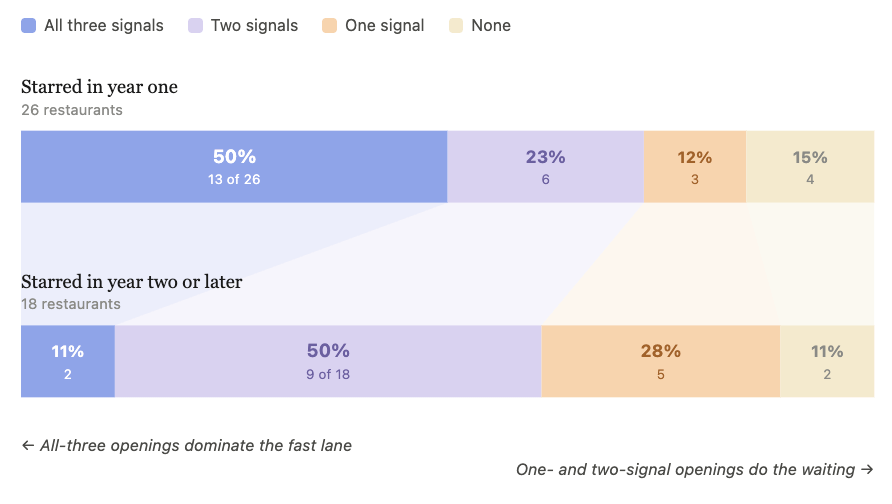
The composition of who stars in year one versus year two tells the story clearly. All restaurants with three signals account for 50% of year-one stars and drop to 11% by year two.
One signal openings do the opposite, 12% in year one, 28% in year two and beyond. The restaurants with everything working in their favour get found first, the ones making inspectors work harder get there eventually, but later.
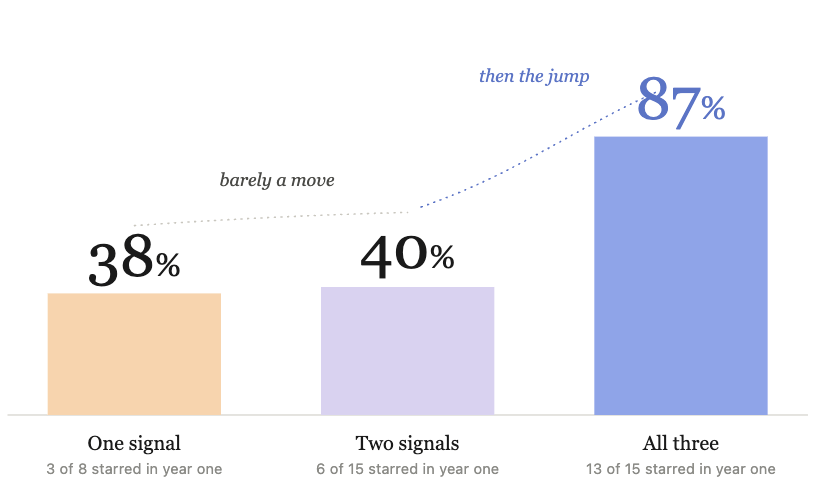
Restaurants opening with one signal starred in year one 38% of the time. Two signals: 40%… barely a move. All three signals star 87% of the time in year one.
Whilst meeting all three signals doesn't guarantee a year-one star, it nearly doubles the odds against everything below it, and across five years of ceremonies, there hasn’t been a single opening with all three signals that hasn’t eventually starred.
What this suggests is the restaurants where all three signals are present are the ones to watch out for, especially if you’re trying to
What the outliers tell you:
Here is what I find more interesting than the rule: the 6 restaurants that earned a star but met none of the three signals.
AngloThai ran as a pop up for nearly a decade before going permanent in November 2024 and earning a star three months later. Chishuru’s Adejoké Bakare is self-taught, relocated from Brixton to Fitzrovia, and starred within six months of reopening. OMA, Greek, sharing plates, Borough Market. Lita, open fire, à la carte, Marylebone, starred in Year 1. None arrived with a Le Gavroche lineage or a Four Seasons behind them.
What they had instead was years of earned credibility, critical momentum, long standing cult status, and a version of pedigree that doesn’t show up on a CV. AngloThai had a cult following before opening its permanent location. The framework explains most of the picture and the outliers tell you where its edges are.
When you look closely at those edges, two things emerge.
The postcode layer
Pedigree, Format and Platform are all clarity signals, but we also need to take a look at the role post code plays in all of this.
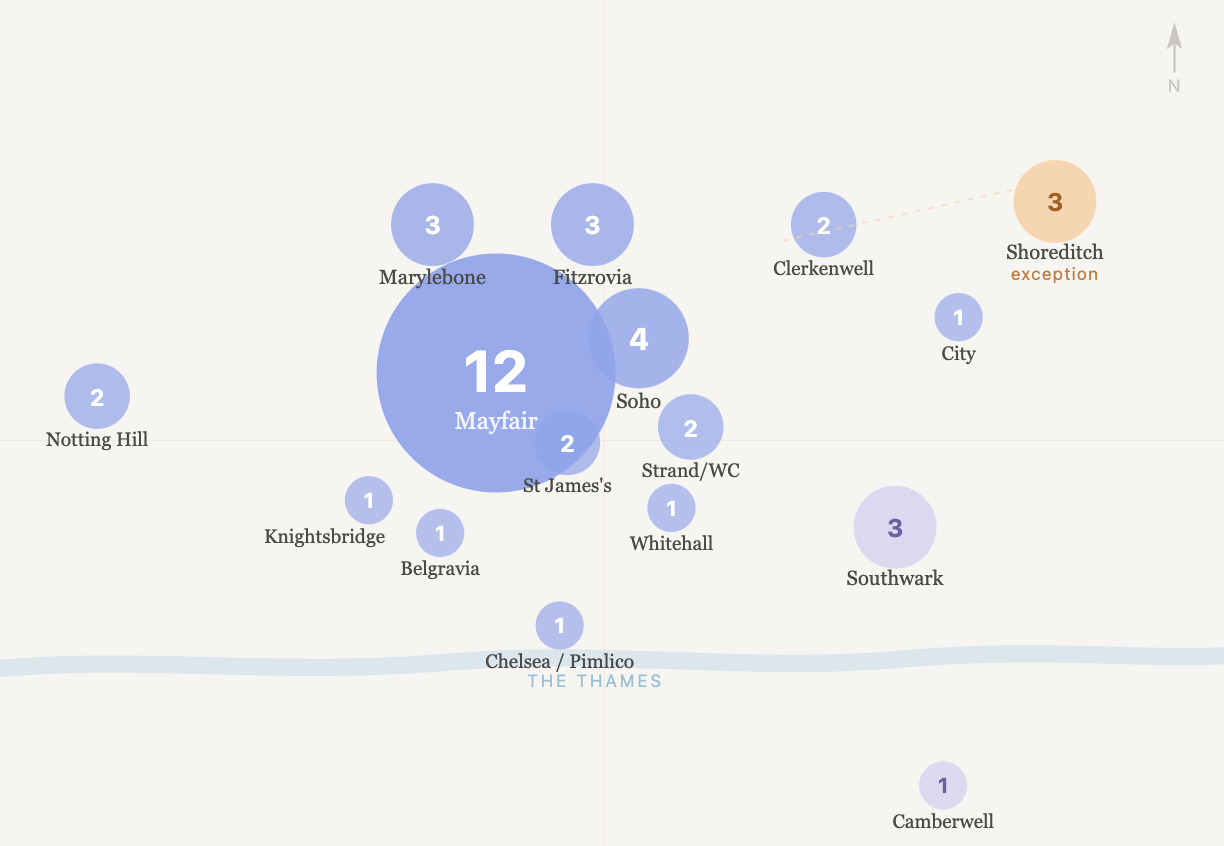
Of the 44 restaurants that earned their first star across the last five ceremonies, the overwhelming majority sit inside a tight corridor of central London: Mayfair, Knightsbridge, St James’s, Belgravia, Fitzrovia, Marylebone. That’s not a coincidence of quality, it’s the clarity that comes with post codes where serious intent is assumed, infrastructure exists to open fully formed, and inspectors return most frequently.
The most instructive data point in the entire analysis is Chishuru. Adejoké Bakare opened in Brixton in September 2020. Time Out’s Restaurant of the Year in 2022, but no Michelin star was awarded. She closed, rebuilt, and reopened in Fitzrovia in September 2023 and within six months, Chishuru received its first star.
Same chef, same cuisine, same cooking, but now in a different postcode.
An inspector visiting Fitzrovia arrives with a different set of assumptions than one visiting Brixton Market. That’s not a statement about the quality of either neighbourhood, it’s a statement about how assessment systems work and what they unconsciously weight.
Shoreditch is the one clear exception, Cycene, Plates London, and Legado all starred in year one from east London addresses. But each had something compensating for the postcode: a tasting menu, a pedigreed chef, or JKS Restaurants as the platform behind them. When you’re not in Mayfair, you need more of the other signals to make up the difference.
The areas to watch for slower, harder earned recognition: Peckham, Hackney, Bermondsey. Those restaurants will take longer, but they also tend to be the ones that reward attention paid early.
The cuisine problem
Geography and cuisine turn out to be the same problem framed differently. Both are questions about clarity, about which signals the guide reads fastest and which it takes longer to trust.
Modern French and modern European account for roughly a third of all 44 first recognition restaurants with Japanese omakase following closely behind. These are the categories where format and cuisine reinforce each other, and where inspectors have the deepest existing language for assessment.
Non-European cuisines tell a more complicated story. West African, Korean, Indian, Mexican, and Greek all appear in the dataset, but almost all took longer, or only starred quickly when presented in a format or postcode that made them legible on conventional fine dining terms. Chishuru in Fitzrovia, not Brixton. Somssi inside the Mandarin Oriental. DOSA at a marble counter in Mayfair.
Kol and AngloThai are the two that break this pattern most interestingly, and both appear in the outliers cohort for good reason. Neither had the conventional framework working in their favour, but both had built enough momentum that the guide had essentially already made up its mind before they opened a permanent door.
Which points to the conclusion the outliers section as a whole is really making: the guide is not indifferent to new categories, new postcodes, or new cuisines. But it needs a reason to believe in a restaurants potential, and Pedigree, Platform, and Format are the fastest route to providing that reason.
How to use this framework
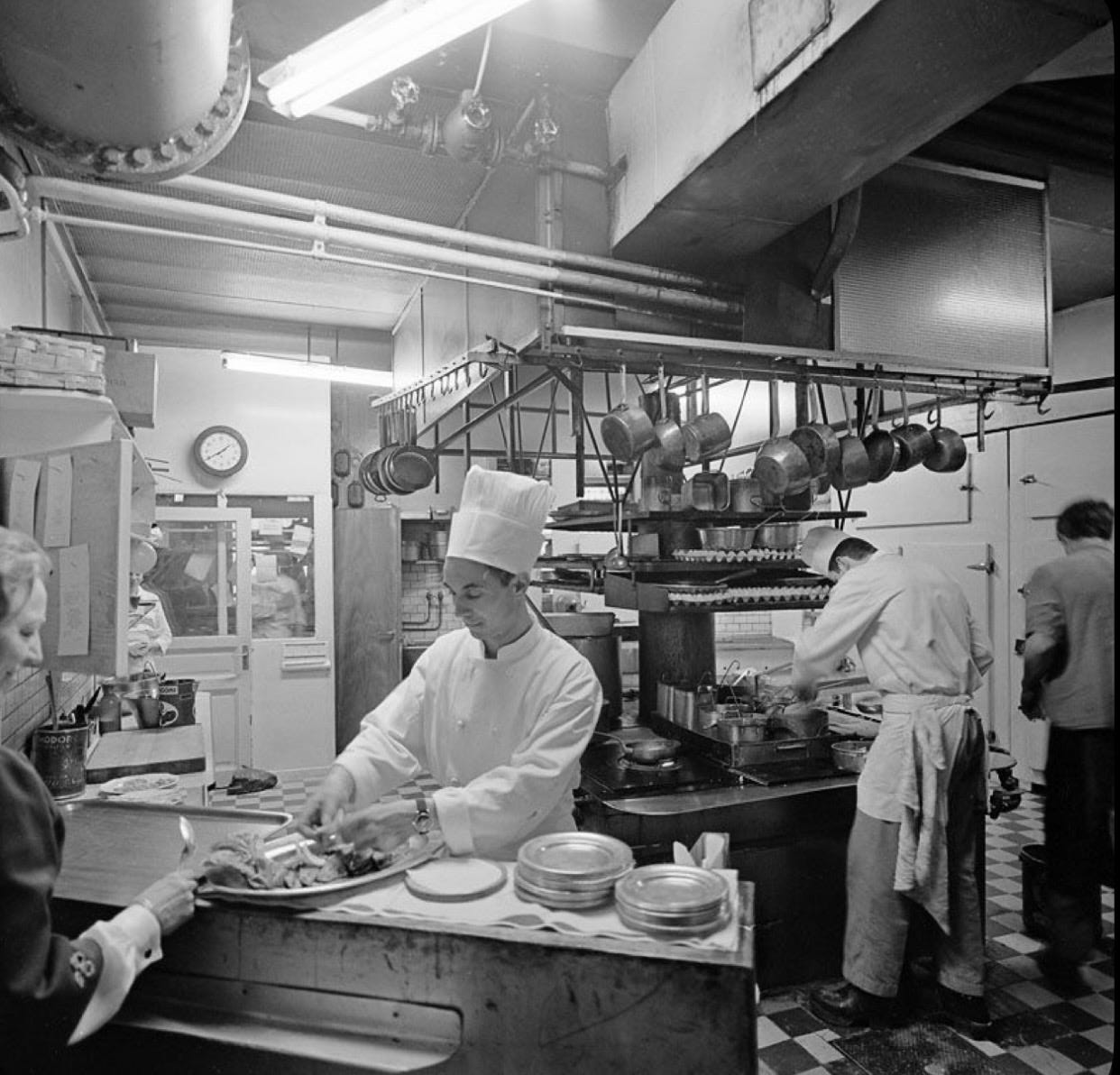
The guide will never tell you where it’s looking next, that’s not how it works. But the signals are visible before the inspectors arrive, and once you know what you’re looking for, it becomes an informed bet on getting there before Michelin does.
The configuration to look for: a chef whose CV runs through a two or three star kitchen in a senior role, a format that declares its ambition clearly (tasting menu, omakase counter, or chef’s table) and a serious operator or luxury hotel behind it. All three present simultaneously is rare, but when it happens, it’s almost a sure bet to a star.
Two signals gets you there eventually, and one signal means you’re in a very large crowd. No signals and you’re either too early, or you’re watching something the guide will take years to catch up with, which has its own rewards when discovered early.
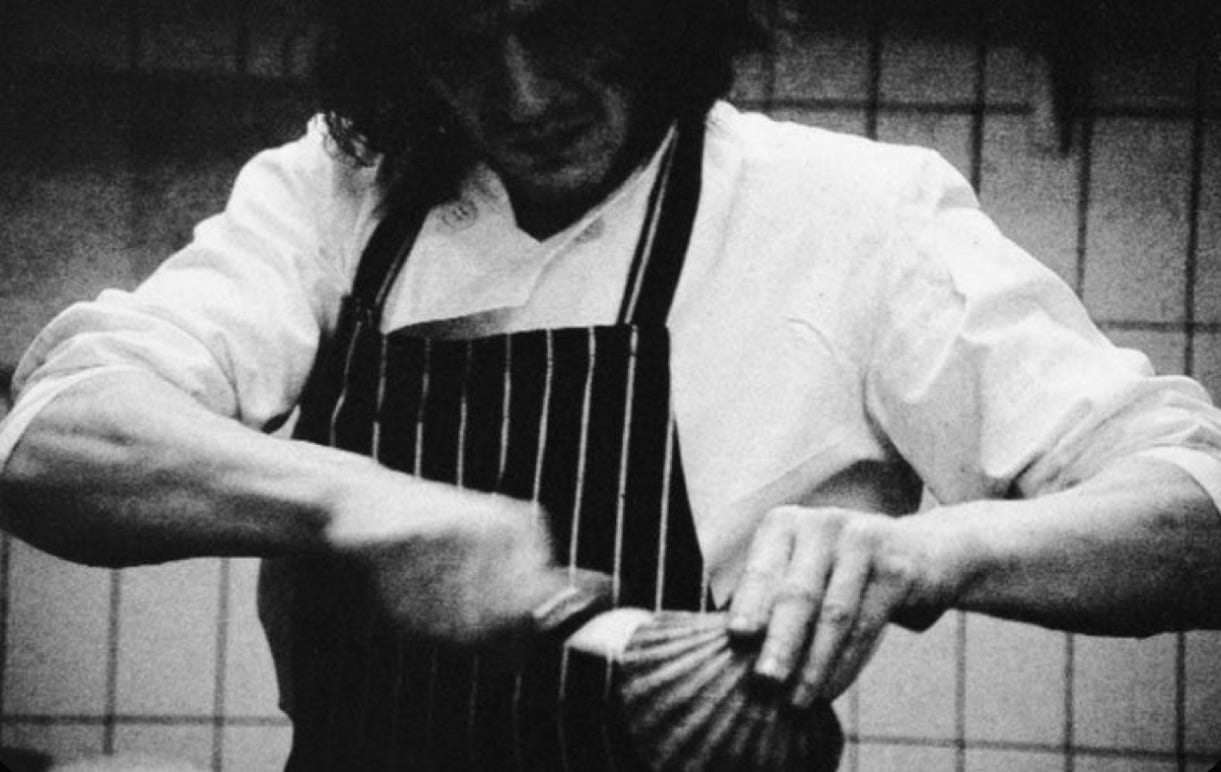
The practical implication: when a restaurant opens that meets all three criteria, book it immediately.
Next week, I’m applying this framework to every serious 2026 London opening to identify the restaurants most likely to be awarded a star in 2027. The list is shorter than you’d expect.
All data drawn from Michelin Guide Great Britain & Ireland ceremonies 2022–2026. Research was initially sourced using Claude Opus 4.8 and opening dates and chef histories verified across restaurant press and primary listings.
Table for Two lives at the intersection of food and culture, not simply recommendations, but a considered point of view on why dining matters, and where to find the best of London's table culture. If this piece resonated, please support us by subscribing.
love this - learnt a lot, thank you!!